6.20.2011

High Line Background: West Chelsea/Gallery District

Building use in West Chelsea has transitioned from manufacturing to warehousing to industrial. During the middle of the twentieth century, highways began to replace rail as the preferred method of freight transportation. By the 1960s, large sections of the High Line were already being dismantled with traffic along the railway halted altogether in 1980.
Beginning in the 1960s, the number of large industrial firms headquartered in Manhattan significantly declined. This decline continued into the 1970s as disinvestment decimated the city’s previously thriving manufacturing economy. The effects of the decline stretched to related sectors as well, taking a toll on trucking, warehousing, and wholesaling. By the 1990s, New York could no longer claim to be an “industrial city.” This economic shift led to new uses for the large spaces of the old industrial buildings, one of the more innovative adaptations being nightclubs in West Chelsea.  
The “gritty industrial neighborhood,” as it was described in the New York Times in 1997, began to attract art galleries and related businesses, many which were being priced out of SoHo. Among the attractions for artists of the old industrial buildings were the ground stories featuring wide expanses of column free space, 13-foot ceiling heights, and eight-foot-tall operating windows available in many of the buildings.
Today, West Chelsea remains a thriving district for galleries and art-related businesses, with more than 50 percent of the district’s buildings dedicated to these uses.
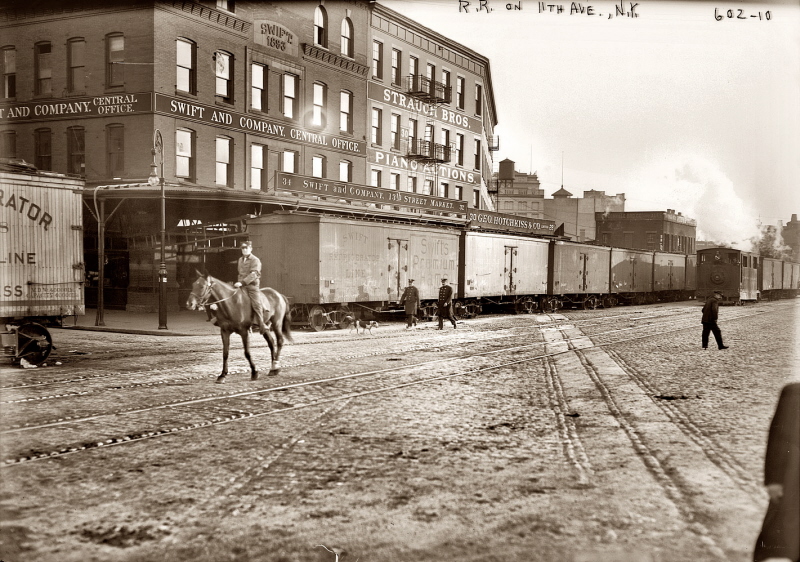
New York Central Railroad - Meat Packing District - Eleventh* Avenue & West 12th Street - ca. 1911
Man on horse is a NYCRR Watchman / RR Policeman a/k/a "West Side Cowboy" escorting the locomotive as required by NY City law.
Source: trainweb.com
Source: Gaytravelabout.com

The Meatpacking District now includes retail, galleries, restaurants, and hotels.
Source: Meatpacking District Improvement Association map 5/2/09


Source:
Christopher D. Brazee & Jennifer L. Most, New York City Landmarks Preservation Commission "West Chelsea Historic District Designation Report" July 15, 2008

6.19.2011

Above & Below

Brian Cronin

Has the High Line caused gentrification?  Who walks above the residents and business owners of the neighborhoods below?  Who are the neighbors and business owners impacted most?


Neighborhood Context Map
Source: thehighline.org
While the High Line has been praised and awarded by urbanists, green enthusiasts, visitors and architects, some criticism has come from its closest neighbors.  Residents and business owners are coping with the influx of tourist traffic, increasing property values, and new upscale development in West Chelsea, the Meat Packing and Gallery districts.

As a public park, the High Line is available to everyone; however, its success has resulted in higher than expected maintenance costs and increased development interest.  For now, Friends of the High Line, the non-profit that manages the park, must raise operating funds privately having abandoned efforts to secure sufficient local support for a business improvement district.  As 2-story walk-ups, auto repair shops, and the last few butchers shops are replaced with luxury hotels, innovative architecture, and fashion retail, the contrast between those above and below the High Line will continue to transition.

6.18.2011

High Line Zoning Changes

On June 23, 2005, the City Council approved applications for the West Chelsea/High Line proposal. The adopted actions include Zoning amendments to allow for creation of a new Special West Chelsea District and rezoning portions of the West Chelsea area from M1-5 light manufacturing zoning to allow mixed commercial and residential development. The Council also approved acquisition and site selection of the High Line by the city to facilitate its reuse as a public open space via TDRs.  Transferable development rights are means of transferring property rights such as building heights, floor area ratios, and other physical attributes between owners to allow for development/construction flexibility.

The West Chelsea rezoning proposal contains provisions intended to enhance the proposed High Line open space and to ensure that adjacent developments engage with and relate to the High Line. To encourage preservation of light and air around the High Line, the proposal would allow development rights to be transferred from High Line properties to designated receiving sites within the Special West Chelsea District. New development along Tenth Avenue, adjacent to the High Line, would also be subject to a series of building bulk and use controls to encourage connections to the High Line and the preservation of light, air and views.
Source: West Chelsea Zoning Proposal

6.17.2011

High Line Transitions

Source: New York Times Aug 2010
At the foot of the High Line is the Meat-Packing District, an area that has seen its share of transition.  When industrial freight deliveries stopped coming through, the area became during the 1980s "notorious as a postindustrial wasteland, populated by body shops, truck yards, and transvestite prostitutes". (New York Magazine) The High Line winds from the Meat-Packing District up through the Gallery District and West Chelsea, with Phase III planned to reach nearly to Clinton.  Since the High Line development has begun and bolstered by celebrity endorsements, the neighborhoods below are now home to condominiums and luxury rentals as well as restaurants and retail, making the High Line park a destination in its own right. Many view it as an urban green oasis. Others see it as culture-less and a harbinger of displacement.


“The High Line has been a very positive influence to push activities to Washington [St.], which was sort of a back street, but now it’s become very prime,” Mr. Pariser said. (New York Times)


A rendering of the design for the new Downtown Whitney Museum of American Art on Gansevoort St., viewed from the south. The High Line park is at right.
Source: The Villager
Source: Urban Sherp June 2009


Sources:
New York Times "As a Park Runs Above, Deals Stir Below" August 10, 2010
The Villager "Whitney Museum is still on track for 2012 opening"
New York Magazine "The High Line: It Brings Good Things to Life"
Urban Sherp "The High Line Greenspace Opens in NYC" June 17, 2009