Showing posts with label adaptive re-use. Show all posts

6.20.2011

High Line Background: West Chelsea/Gallery District

Building use in West Chelsea has transitioned from manufacturing to warehousing to industrial. During the middle of the twentieth century, highways began to replace rail as the preferred method of freight transportation. By the 1960s, large sections of the High Line were already being dismantled with traffic along the railway halted altogether in 1980.
Beginning in the 1960s, the number of large industrial firms headquartered in Manhattan significantly declined. This decline continued into the 1970s as disinvestment decimated the city’s previously thriving manufacturing economy. The effects of the decline stretched to related sectors as well, taking a toll on trucking, warehousing, and wholesaling. By the 1990s, New York could no longer claim to be an “industrial city.” This economic shift led to new uses for the large spaces of the old industrial buildings, one of the more innovative adaptations being nightclubs in West Chelsea.  
The “gritty industrial neighborhood,” as it was described in the New York Times in 1997, began to attract art galleries and related businesses, many which were being priced out of SoHo. Among the attractions for artists of the old industrial buildings were the ground stories featuring wide expanses of column free space, 13-foot ceiling heights, and eight-foot-tall operating windows available in many of the buildings.
Today, West Chelsea remains a thriving district for galleries and art-related businesses, with more than 50 percent of the district’s buildings dedicated to these uses.
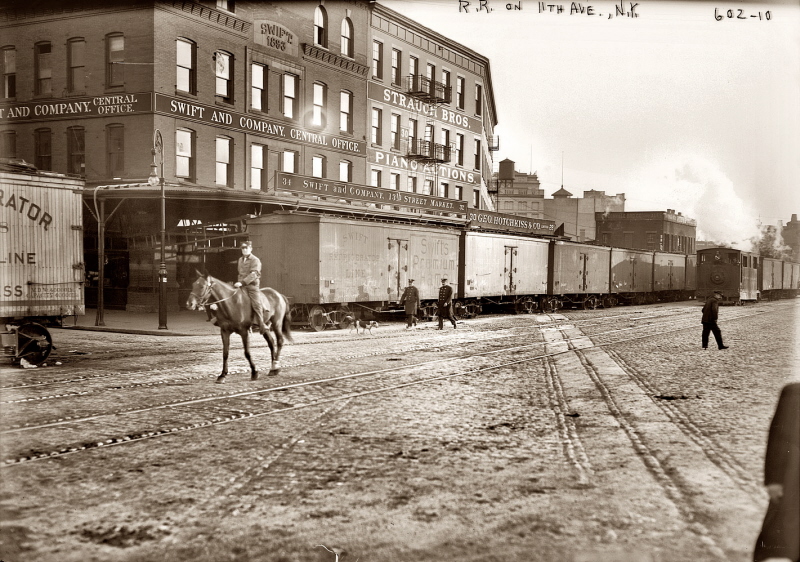
New York Central Railroad - Meat Packing District - Eleventh* Avenue & West 12th Street - ca. 1911
Man on horse is a NYCRR Watchman / RR Policeman a/k/a "West Side Cowboy" escorting the locomotive as required by NY City law.
Source: trainweb.com
Source: Gaytravelabout.com

The Meatpacking District now includes retail, galleries, restaurants, and hotels.
Source: Meatpacking District Improvement Association map 5/2/09


Source:
Christopher D. Brazee & Jennifer L. Most, New York City Landmarks Preservation Commission "West Chelsea Historic District Designation Report" July 15, 2008

6.18.2011

High Line Zoning Changes

On June 23, 2005, the City Council approved applications for the West Chelsea/High Line proposal. The adopted actions include Zoning amendments to allow for creation of a new Special West Chelsea District and rezoning portions of the West Chelsea area from M1-5 light manufacturing zoning to allow mixed commercial and residential development. The Council also approved acquisition and site selection of the High Line by the city to facilitate its reuse as a public open space via TDRs.  Transferable development rights are means of transferring property rights such as building heights, floor area ratios, and other physical attributes between owners to allow for development/construction flexibility.

The West Chelsea rezoning proposal contains provisions intended to enhance the proposed High Line open space and to ensure that adjacent developments engage with and relate to the High Line. To encourage preservation of light and air around the High Line, the proposal would allow development rights to be transferred from High Line properties to designated receiving sites within the Special West Chelsea District. New development along Tenth Avenue, adjacent to the High Line, would also be subject to a series of building bulk and use controls to encourage connections to the High Line and the preservation of light, air and views.
Source: West Chelsea Zoning Proposal

6.07.2011

Atlantic Yards


The Atlantic Yards development project is a controversial mixed-use development project under construction between Prospect Heights and Fort Greene in Brooklyn to include residential and commercial high-rises, as well as a sports arena for the New Jersey Nets. Developer Forest City Ratner has faced tense opposition for various community groups since the plans were announced in 2003 due to questionable use of eminent domain, criticism of design plans, and opposition to changing the character of the surrounding neighborhoods. Currently under construction, the project will undoubtedly change the aesthetics of the Flatbush and Atlantic Avenue corridor and its primarily residential surrounding communities.